
How to Order School Sport Australia Merchandise: A Step-by-Step Guide for First-Time Buyers
New to ordering school sport merchandise? Follow our practical step-by-step guide to avoid costly mistakes and get the right gear for your Australian school.

Written by
Mason Park
Custom Apparel
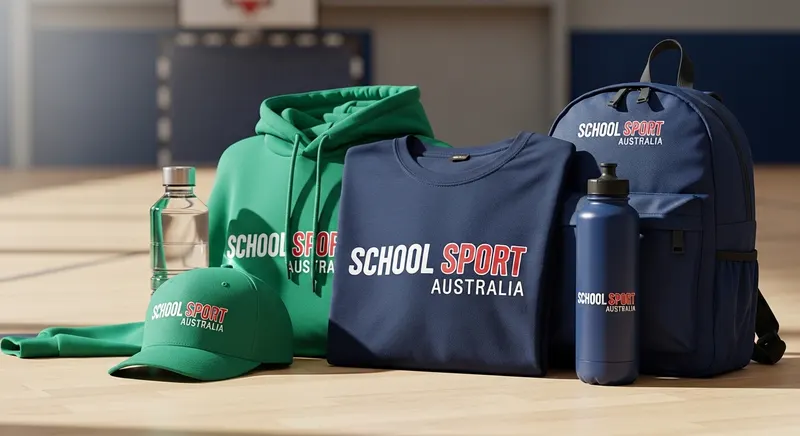
What Nobody Tells You Before Your First School Sport Merchandise Order
Organising merchandise for a school sporting event sounds straightforward until you’re three weeks out from your athletics carnival, your supplier has just asked for a print-ready vector file, and you’ve realised the minimum order quantity is twice what you budgeted for. It happens more often than you’d think — and it happens to well-meaning, organised people who simply didn’t know what questions to ask at the start.
This guide exists to change that. Whether you’re a sports coordinator at a Melbourne primary school placing your first ever bulk order, a P&C volunteer helping kit out a regional New South Wales swimming team, or a school administrator preparing for a School Sport Australia state championship, the following steps will walk you through the full decision-making process — including the pitfalls that catch out first-timers and how to sidestep them entirely.
Step 1: Define Your Purpose Before You Browse a Single Product
The single biggest mistake first-time buyers make is jumping straight to product browsing before they’ve clearly defined what the merchandise needs to accomplish. School sport Australia merchandise generally falls into one of two distinct categories, and confusing them leads to wasted money.
Competition and training apparel covers items students will actually wear during sport — sublimated jerseys, polo shirts, shorts, track jackets, and the like. These pieces need to be durable, colour-fast, and compliant with any competition rules around uniforms. Decoration methods must hold up to repeated washing and physical activity.
Event and recognition merchandise covers everything distributed at carnivals, award ceremonies, and presentation nights. Branded caps, water bottles, tote bags, lanyards, medal ribbons, and printed notebooks all fall here. Function matters less than perceived value and visual impact.
Before you request a single quote, write down the answers to these three questions:
- Will students be wearing this item during competition, or is it a keepsake?
- Who is the primary recipient — students, families, staff, or volunteers?
- Is this a one-off event order or part of an ongoing annual program?
Your answers will shape every decision that follows, from product selection to decoration method to minimum quantities.
Step 2: Nail Down Your Numbers Early (and Add a Buffer)
Quantity drives almost everything in promotional merchandise — unit cost, lead time, decoration method, and even which products are available to you. Getting your numbers wrong at this stage creates expensive problems later.
How to calculate your quantity:
- Start with your confirmed participant count (students competing or attending)
- Decide whether staff, volunteers, and parents are included in the order
- Check whether your event has a history of last-minute additions (most school carnivals do)
- Add a minimum 10% buffer to your final number
That last point is critical. Promotional merchandise suppliers work to exact production runs. If you order 95 caps for a school sport Australia athletics day and 106 students show up, you cannot simply ring and request 11 more at the same price. The unit cost for a top-up order of 11 pieces will be dramatically higher, and the lead time will likely push past your event date.
Common pitfall: Basing your quantity on last year’s attendance figures without accounting for growth. School populations shift, and a popular interschool competition can draw significantly more participants than the previous year. Build that buffer in from the start.
Step 3: Set a Realistic Budget Per Head
School sport merchandise budgets in Australia vary enormously — from a P&C committee spending $4 per student on a branded lanyard for a local carnival, to a school sport association investing $45 per athlete in a full sublimated uniform package for a School Sport Australia national event. Neither is right or wrong; they serve different purposes.
What matters is arriving at a per-head figure before you approach suppliers, not after. Here’s a practical way to think about it:
- Under $8 per person: Stick to single-item essentials — a cap, a water bottle, or a tote bag with basic logo printing
- $8–$20 per person: Opens up multi-item options, or a single higher-quality product such as a embroidered polo or a sublimated microfibre towel
- $20–$50 per person: Appropriate for competition uniforms, full event packs, or premium commemorative items for state or national-level competitions
- $50+ per person: Reserved for elite competition kits or full apparel packages covering jersey, shorts, jacket, and bag
Common pitfall: Forgetting to include decoration costs in your per-head budget. A blank polo at $18 might look affordable, but once you add embroidery setup fees, the actual cost per unit often jumps considerably. Always ask for a fully decorated, delivered price in your initial quote.
Step 4: Gather Your Artwork Before Contacting Suppliers
This step alone saves weeks of back-and-forth. Suppliers need print-ready artwork to produce accurate proofs and quotes — and “print-ready” means something specific in the promotional products world.
What you need:
- Your school crest or logo in vector format (.ai, .eps, or high-resolution .pdf)
- Pantone colour codes for your school colours, or at minimum the HEX codes
- Any competition-specific branding guidelines from School Sport Australia or your state body
- Written confirmation of what text or additional elements need to appear on the product (year, event name, school name, student names if applicable)
If you don’t have vector artwork: Contact your school’s front office or IT coordinator — the logo used on your school’s letterhead is often available in the right format. If not, many merchandise suppliers offer artwork creation services for a fee, which is worth factoring into your budget.
Common pitfall: Submitting a logo cropped from your school’s website. Website images are typically 72 DPI and will produce blurry, unprofessional results when printed or embroidered at scale. A logo that looks sharp on a screen can be completely unusable for physical decoration.
Step 5: Understand Decoration Methods and Which One Suits Your Product
Not all branding is created equal, and the decoration method you choose affects durability, appearance, colour accuracy, and cost. For school sport Australia merchandise, the most common methods are:
Embroidery — Thread stitched directly into fabric. Excellent for polos, caps, and jackets. Highly durable and professional-looking. Best suited to simpler logos without fine detail or gradients. Requires a one-off digitising fee (typically $30–$80) that’s spread across your order.
Screen printing — Ink pressed through a stencil onto flat fabric. Cost-effective for large runs of t-shirts and tote bags. Each colour requires a separate screen (and often a separate setup fee), so designs with many colours become expensive. Not suitable for curved surfaces or highly textured fabrics.
Sublimation printing — Dye infused directly into polyester fabric using heat. Produces full-colour, photographic-quality results with no feel on the fabric surface. Ideal for competition jerseys, microfibre towels, and any item where bold colour is critical. Only works on white or very light polyester — not suitable for cotton.
Digital transfer / DTF (Direct to Film) — A newer method that allows full-colour, detailed designs on virtually any fabric. Sits slightly proud of the fabric surface. Excellent for small runs and complex designs. Durability is generally good but may be slightly less than embroidery for heavy-use garments.
Common pitfall: Choosing embroidery for a complex, multi-colour school crest with fine linework. Embroidery has a minimum stitch size, meaning small text and intricate detail can become unreadable. Ask your supplier to show you a test swatch or a previous embroidered example of a similar design complexity before committing.
Step 6: Ask the Right Questions When Comparing Suppliers
Once you have your brief — purpose, quantity, budget, artwork, and preferred decoration method — you’re ready to approach suppliers. Request quotes from at least two or three to compare, and make sure you’re comparing apples with apples.
Essential questions to ask every supplier:
- What is your standard lead time from approved artwork to delivery?
- Is that lead time guaranteed, or is it an estimate?
- What is your minimum order quantity for this product?
- Does your quoted price include all decoration setup fees and GST?
- Do you provide a physical or digital proof before production begins?
- What is your policy if items arrive with production errors?
- Can you deliver directly to our school address in [your suburb/city]?
Common pitfall: Choosing purely on price. The cheapest quote is sometimes the cheapest for a reason — lower quality blanks, less reliable lead times, or hidden fees that appear on your final invoice. Ask to see samples of previous work for school or sporting clients, and check whether the supplier has experience working with school budgets and approval processes.
Step 7: Build in Realistic Lead Times for the Australian School Calendar
Lead time is where the majority of first-time buyers come unstuck. The Australian school sporting calendar is highly concentrated — state carnivals cluster in Term 1 and Term 3, and there’s a predictable surge in merchandise orders in the weeks before these events.
General lead time guidelines (confirm with your specific supplier):
- Screen printed and embroidered garments: 10–15 business days from artwork approval
- Fully sublimated competition jerseys: 15–25 business days from artwork approval
- Promotional items (caps, water bottles, bags): 10–20 business days from artwork approval
- Rush orders: Available from some suppliers, typically at a 20–40% premium
Work backwards from your event date. If your School Sport Australia regional carnival is on a Friday in Week 6 of Term 1, you need your artwork approved and order placed no later than mid-December of the previous year to avoid rush fees and stress.
Common pitfall: Assuming public holidays don’t affect lead times. Christmas–New Year, Easter, and state-specific public holidays like Melbourne Cup Day in Victoria can add several days to standard production schedules. Always confirm lead times specifically around these periods.
Step 8: Plan for Distribution and Storage
This step is easy to overlook, but it creates genuine logistical headaches if you don’t think it through in advance.
Sizing: If you’re ordering garments, you need to collect sizes from students before placing your order. Create a simple Google Form or paper-based size collection sheet and give yourself at least two weeks to chase responses. Build your size breakdown around your returns before adding your buffer quantity in larger, more common sizes.
Storage: A pallet of 200 custom polo shirts in individual polybags takes up more space than most coordinators expect. Confirm where merchandise will be stored on arrival and who is responsible for receiving the delivery.
Distribution: Decide whether merchandise will be handed out at the event, distributed through home groups in advance, or available for collection from the front office. Each approach has implications for staffing, record-keeping, and the likelihood of items going missing.
A Final Word on Getting It Right the First Time
Ordering school sport Australia merchandise for the first time is genuinely manageable when you approach it systematically. The coordinators who run into trouble are almost always those who start too late, skip the artwork preparation step, or forget to confirm all-inclusive pricing upfront.
Give yourself more time than you think you need, ask more questions than you think are necessary, and always — always — get your per-unit price confirmed in writing with GST, decoration, and delivery included before you approve anything. Your future self, standing at an event watching students proudly wear gear that arrived on time and looks exactly as expected, will be very glad you did.